Mustard Oil

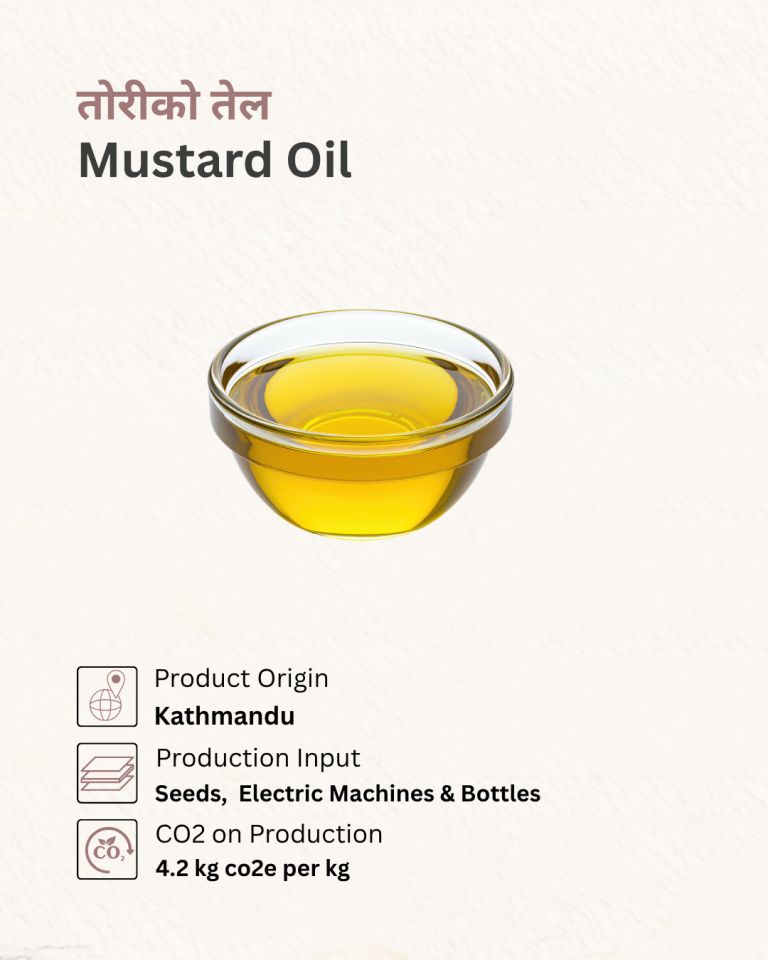
A mustard seed is planted somewhere across the border either in Canada, Australia or India. The land is prepared, seeds are sown, fertilizers are added, water is given, and the crop is harvested, stored and transported to Nepal boarder. Local entrepreneurs of mustard oil are unaware about how much emission has happened. Scope 3 and cradle to gate step are missing from the story.
Once the seeds cross into Nepal, the data wakes up. The trip from the border to a Kathmandu wholesaler consumes 0.5 liters of diesel, adding 0.133 kgCO_2e to its ledger. The data was averaged for 1l of mustard oil, just a tiny breath of the story so far.
The seeds arrive at a storage facility. For six months, they sit in a temperature-controlled room, kept fresh by 4 kilowatt-hours of hydroelectricity. That’s another 0.016 kg of CO₂e – barely a whisper.
Then the seeds are cleaned. A small amount of water removes impurities, using 1 kilowatt-hour of electricity -adding 0.004 kg of CO₂e.
Now comes the heart of the process. The seeds are roasted over a traditional wooden furnace. Two kilograms of wood burn, releasing 0.0298 kg of CO₂e – the warm, smoky smell of the old way.
Next, an electric machine presses and filters the seeds. Six kilowatt-hours of hydro power turn the seeds into golden oil, adding 0.024 kg of CO₂e.
The leftover mustard cake – a byproduct – is sent to feed animals. Zero emissions. Zero waste.
The oil is poured into plastic bottles. But where did the bottles come from? How much carbon did they cost to make? The file is silent.The bottles are packed into cardboard boxes. Again – no numbers.
So far, the oil has released only about 0.2 kg of CO₂e. Now the bottled oil leaves the factory. And this is where the story gets heavy.
First, it travels 10 kilometers to a wholesaler. That short trip burns diesel and releases 2.66 kg of CO₂e – more than ten times everything that came before.Then, it travels another 5 kilometers to a retailer. Another 1.33 kg of CO₂e.
All Product