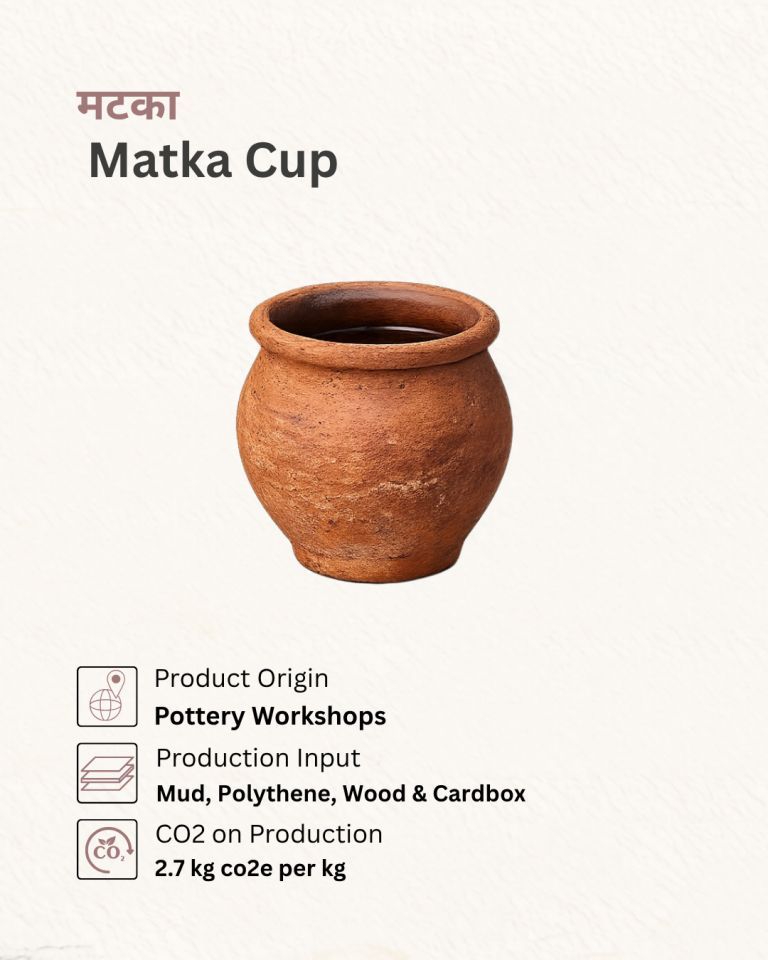
Matka Cup
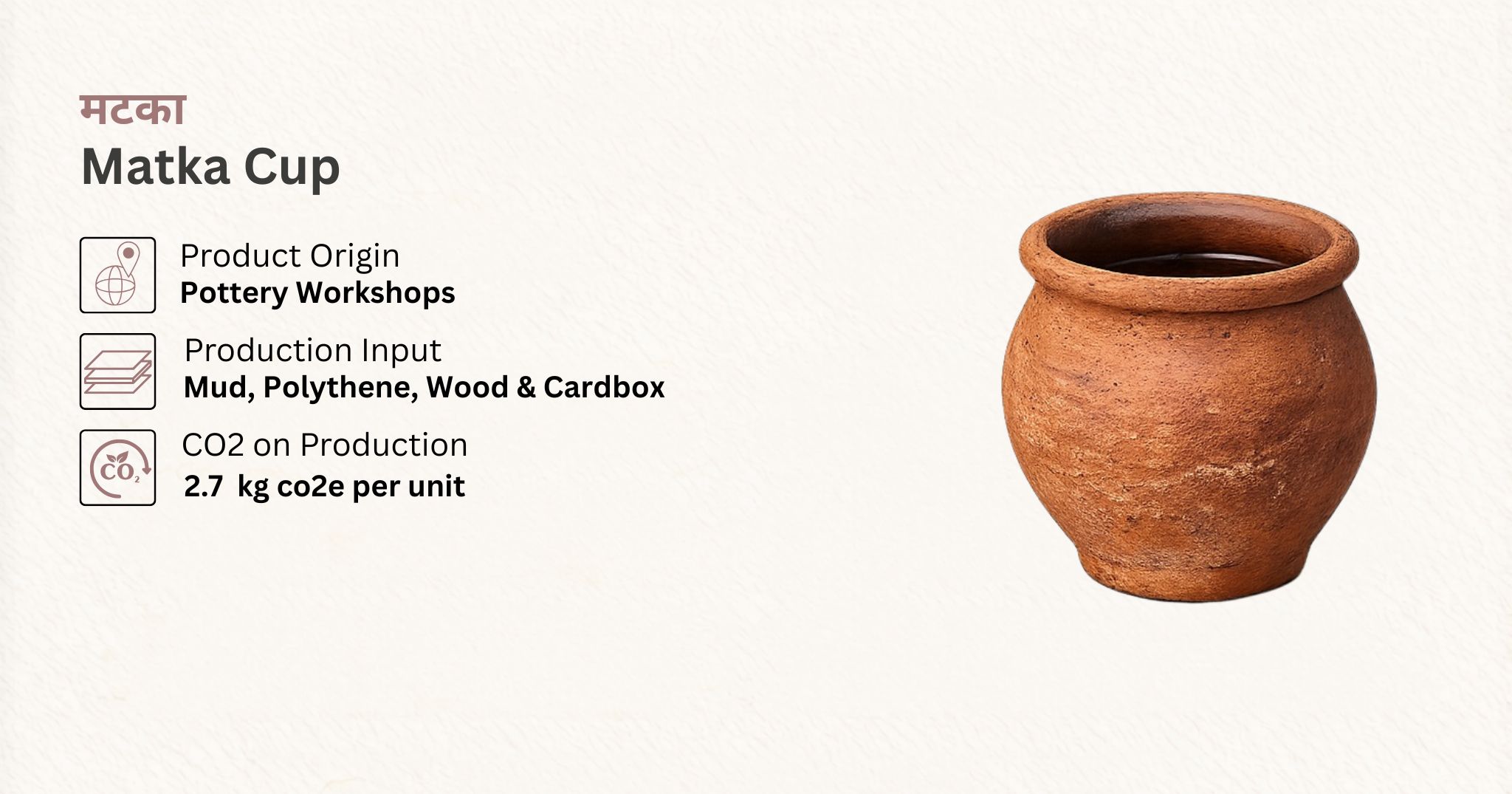
A tiny clay cup holds more than chiya — it holds a journey.
Deep in the Kathmandu Valley, a lump of mud — just 100 grams — is rudely awakened by the roar of a diesel excavator. This is 0.0266 kg of CO₂e already released into the air. The mud doesn’t know it yet, but it’s about to become a matka cup.
The mud is loaded onto a truck and driven 12–15 km to a pottery workshop. The truck burns 3 liters of diesel, puffing out 0.798 kg of CO₂e — nearly 30% of the cup’s entire carbon footprint. The mud is wrapped in a small polythene sheet (negligible, just 0.07% of emissions) and enters the workshop.
Inside, the mud is refined, then spun on an electric potter’s wheel (0.5 kWh electricity, another 0.07% of emissions). It’s left to dry under the free, silent sun — zero emissions, zero drama. Then comes the wooden firing: 1 kg of wood crackles and glows, releasing 0.0149 kg CO₂e (just 0.55% of the total). The cup hardens, turns earthy brown, and feels proud.
After a second sun-dry and a cardboard box (no emissions), the matka cup whispers: “I’m ready.”
But the journey has only begun.
A truck carries it 20–30 km to a wholesaler — 5 liters of diesel, 1.33 kg CO₂e. That’s half of all emissions — 49% of the cup’s life. From there, another truck takes it 20–30 km to a café — 2 more liters, 0.532 kg CO₂e (another 19.6%). The cup finally holds hot chai, fulfills its destiny, and is gently used.
Then, one day, it cracks.
But here’s the twist: the matka cup is degradable. It returns to the earth — no waste transport, no landfill drama. Zero emissions. The mud smiles.
The heaviest part of the matka’s life wasn’t the clay or the fire — it was the road.
All Product