Bhadgaule Topi
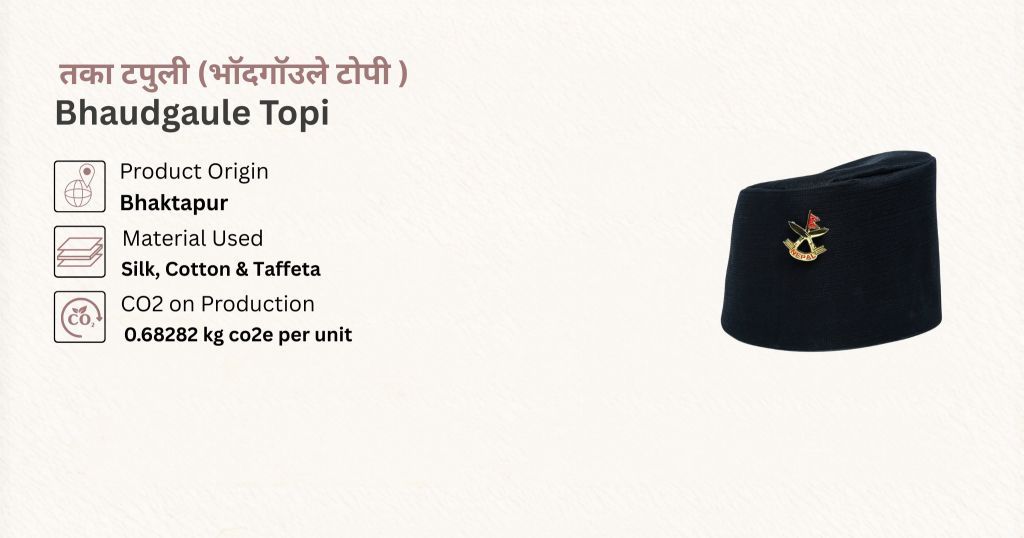
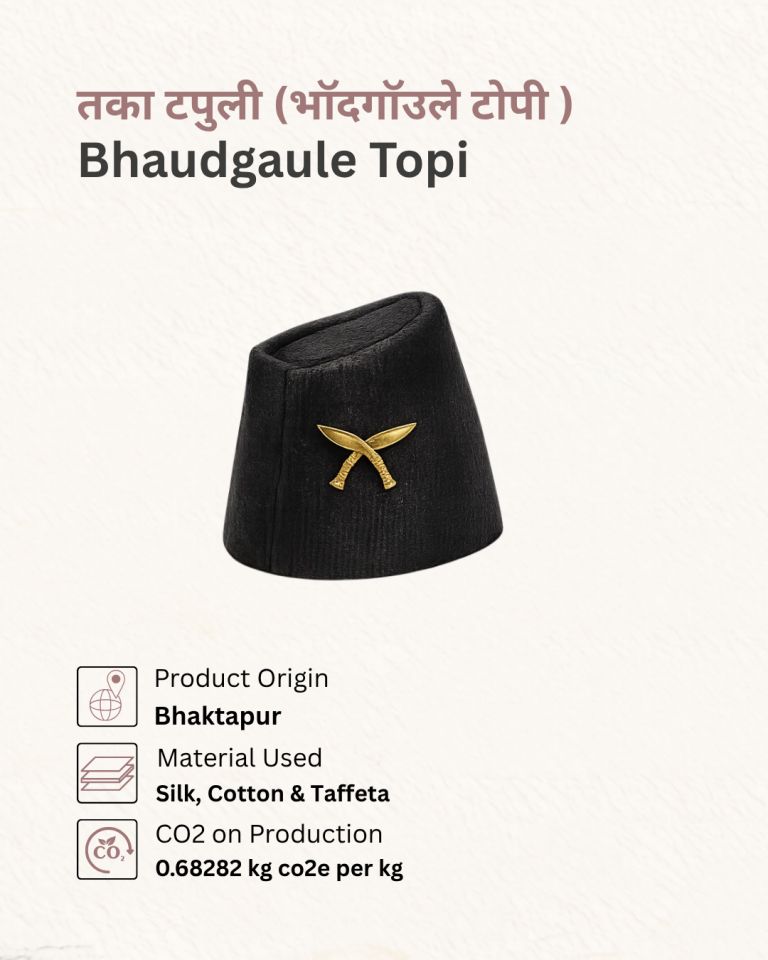
The Bhadgaule Topi begins its life as a combination of three layered fabrics—silk, cotton, and taffeta—already carrying hidden embodied emissions from earlier textile production. While these cradle-to-gate impacts are excluded here, the transformation inside Bhaktapur workshops marks the measurable carbon footprint of its final making.
The three fabric layers are bonded together using all-purpose flour, contributing 0.01475 kg CO₂e. The material is then sun-dried and cut into shape, a natural process that emits 0 kg CO₂e due to solar drying. Stitching and sewing using machines introduces electricity use, adding 0.02 kg CO₂e, while handwork keeps emissions relatively low.
To strengthen the structure, flour is again applied, contributing another 0.01475 kg CO₂e, followed by sun drying, which again produces 0 kg CO₂e. The topi is then polished to achieve its signature black finish, though this stage has no direct emission value recorded in the dataset.
Finally, the finished topi is packed in polythene, adding a major 0.229 kg CO₂e. The product is then distributed through transport stages: delivery to wholesalers (0.133 kg CO₂e), wholesalers to retailers (0.133 kg CO₂e), and retailers to customers (0.133 kg CO₂e), making transportation the dominant emission source.
Overall, the Bhadgaule Topi carries a total carbon footprint of approximately 0.68282 kg CO₂e per unit, with packaging and transport being the most significant contributors, while traditional sun-drying and manual processes help keep production emissions low.
All Product