Bitten Rice
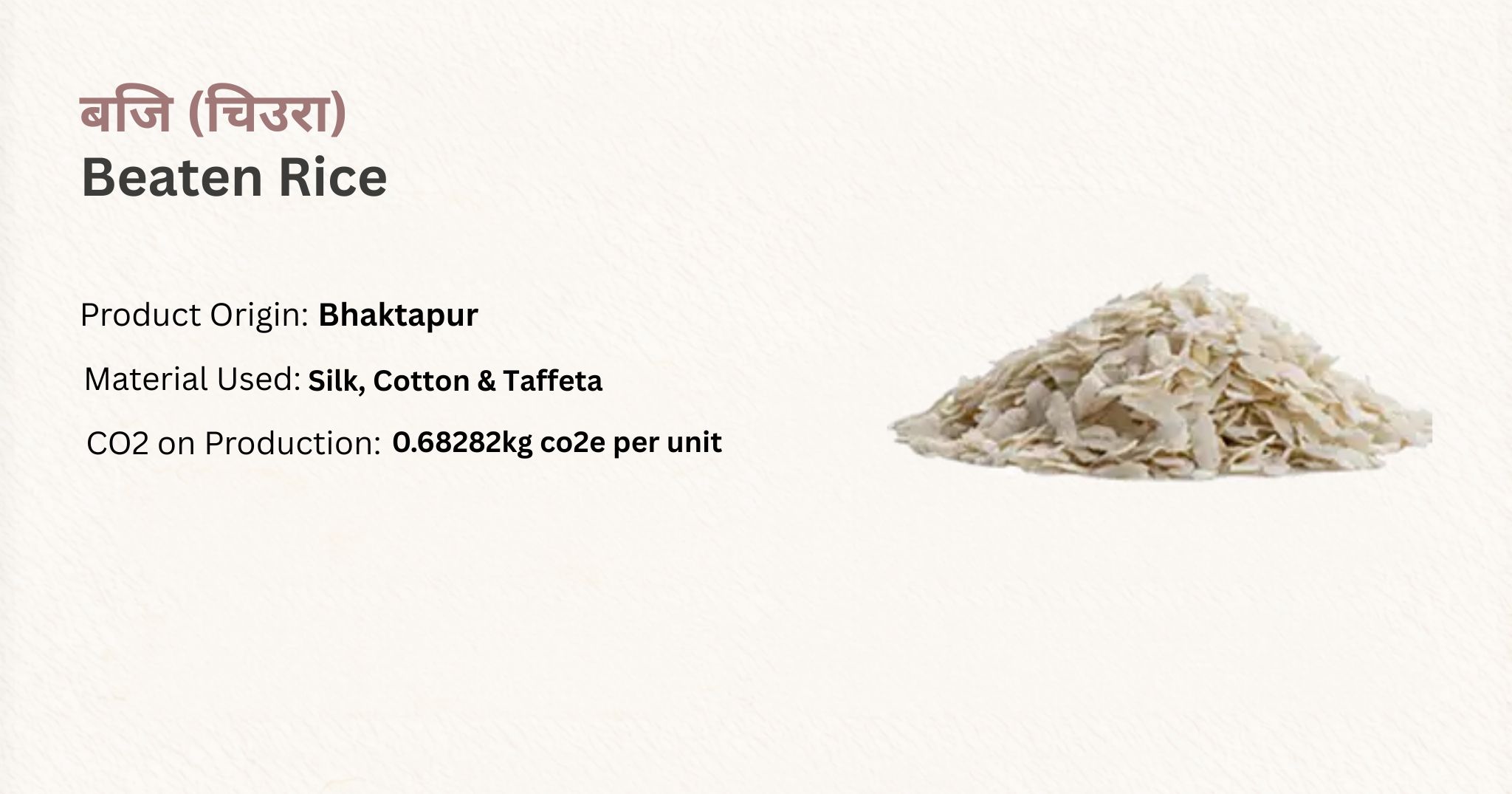
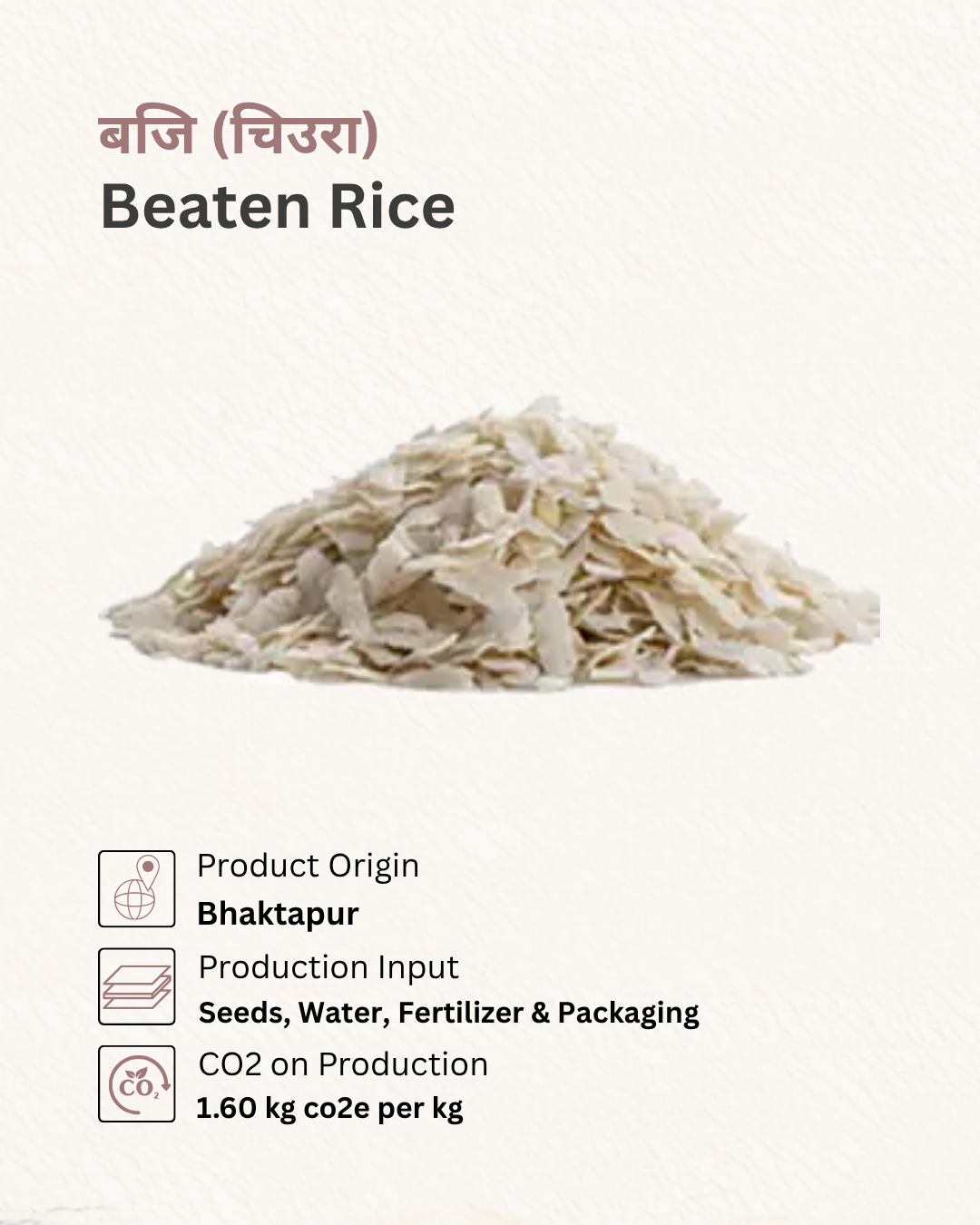
The life cycle of beaten rice (chiura) in Nepal begins in agricultural fields across Kathmandu and nearby hilly regions, although the seed source remains unknown. The first measurable emission occurs during land preparation using diesel, contributing 0.00266 kgCO₂e, while activities such as seed sowing, irrigation, harvesting, and fertilizer application are assumed to have negligible or unaccounted emissions in this dataset.
Once harvested, the paddy is transported to storage facilities, generating 0.266 kg CO₂e,followed by another 0.266 kg CO₂e during transportation to rice mills in Bhaktapur over distances of 50–75 km. At the storage stage, paddy is preserved for up to four months. While most storage processes show negligible emissions, electricity use for maintaining temperature contributes 0.04 kg CO₂e.
The paddy then undergoes cleaning, dehusking, polishing, and grading at the mill. Although these processes consume electricity, their emissions are not quantified in the table. A by-product, rice husk, is generated without additional emissions. Packaging introduces a significant contribution, with plastic or jute bags emitting approximately 0.229 kg CO₂e. Distribution further adds to the carbon footprint as the product moves through different stages: transportation to the wholesaler emits 0.266 kg CO₂e, distribution from the wholesaler to the retailer adds another 0.266 kg CO₂e, and final delivery from the retailer to the household contributes an additional 0.266 kg CO₂e. The process also involves additional steps such as cleaning and drying, which require extra energy, leading to a higher overall carbon footprint.
As a result, the total carbon footprint of beaten rice (chiura) is around 1.60 kgCO₂e per kg.
Every stage in the table contributes, but transportation (total ~1.064 kg CO₂e) and packaging (0.229 kg CO₂e) dominate emissions, while farming and storage appear minimal due to limited data inclusion.
All Product